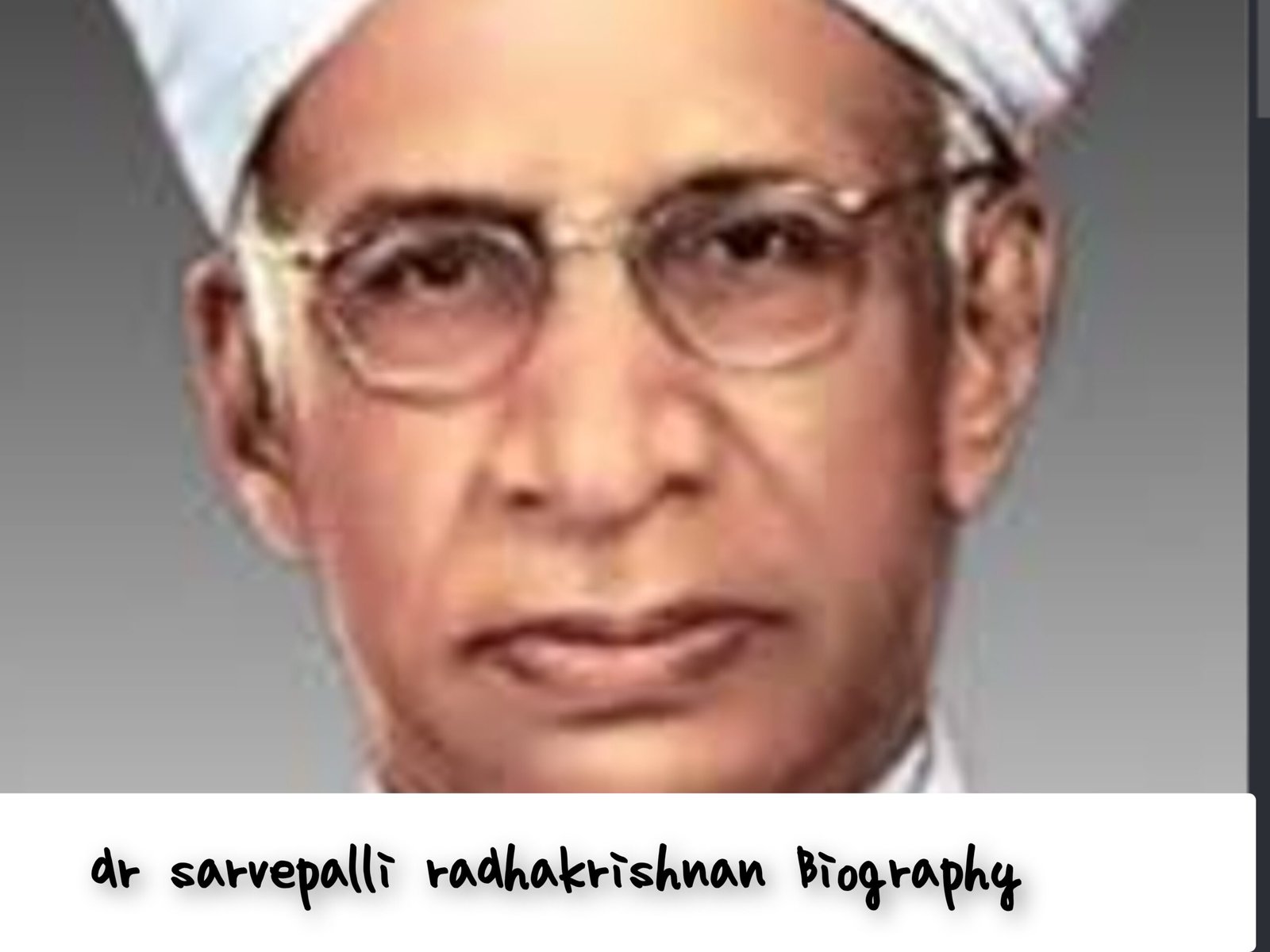
Dr Sarvepalli Radhakrishnan Biography
Dr Sarvepalli Radhakrishnan stands as one of India’s most respected thinkers and leaders. He was born on 5 September 1888 in Tiruttani and passed away on 17 April 1975 in Madras. He worked as a teacher philosopher and statesman. He served as the first Vice President of India from 1952 to 1962 and as the second President of India from 1962 to 1967. His birthday is observed every year as Teachers Day across India. This practice began in 1962 at his own suggestion. The purpose of this article is to present clear facts about his life education family work and lasting influence so that readers can understand his contributions without confusion.
Radhakrishnan came from a simple background yet rose through learning and public service. He explained Indian thought to the world in clear terms. He defended the value of education and teachers. His writings and actions continue to guide discussions on philosophy learning and leadership in India. The sections that follow cover his early years schooling family details known financial habits career path any noted points of debate his lasting impact a short closing summary and answers to common questions.
Dr Sarvepalli Radhakrishnan Early Life
Sarvepalli Radhakrishnan was born on 5 September 1888 in Tiruttani. At that time the place belonged to the Madras Presidency under British rule. Today it is part of Tamil Nadu. His family spoke Telugu and belonged to the Niyogi Brahmin community. His father Sarvepalli Veeraswami worked as a subordinate revenue official for a local landlord. His mother was Sitamma also known as Sita. The family lived with limited means. Radhakrishnan later spoke of poverty as something that shaped character when faced with honesty.
He spent his childhood years in Tiruttani Tiruvallur and Tirupati. These towns formed the early setting of his life. Primary schooling took place at local institutions including Gowdie School in Tiruvallur. He later attended schools in Tirupati such as the Hermannsburg Evangelical Lutheran Mission School. The family faced money constraints yet supported his studies. Official records list 5 September 1888 as his birth date. Some later accounts mentioned slight variations in the year but the accepted public record remains 1888.
From an early age he showed interest in learning. The surrounding culture of temples and local traditions mixed with the presence of missionary schools. This mix gave him early exposure to different ideas. His mother tongue was Telugu. He grew up in a household that valued basic education even under modest conditions. These early years formed the base for his later focus on knowledge and service.
Dr Sarvepalli Radhakrishnan Education
Radhakrishnan received his higher education at Madras Christian College. He joined the college around the age of seventeen. He completed both his bachelor and master degrees in philosophy. His master degree was finished around 1906 to 1908. The exact final year appears as 1906 or 1908 in different records but the achievement is clear. His master thesis carried the title The Ethics of the Vedanta and its Metaphysical Presuppositions. In this work he examined Indian philosophical ideas and responded to questions raised by Western thinkers.
The choice of philosophy came in a practical way. A cousin who studied at the same college gave him three used books. These books covered psychology logic and ethics. The gift directed his attention toward philosophy rather than other subjects. Teachers at the college including figures such as William Meston and Alfred George Hogg marked his work with high scores. The thesis later appeared in print when he was still a young man.
Before Madras Christian College he studied at Voorhees College in Vellore. Earlier schooling in Tiruttani and Tirupati prepared him for college. Scholarships helped him continue studies despite family limits. The education combined Indian traditional ideas with Western methods of study. This blend stayed with him throughout life. He used it to present Indian philosophy in language that scholars outside India could follow. His academic training ended with strong results in philosophy and set the path for teaching and writing.
Dr Sarvepalli Radhakrishnan Personal Life
Radhakrishnan married Sivakamu in 1903 or 1904. She was a distant relative. He was about sixteen years old and she was younger at the time of the arranged marriage. The couple remained together for more than fifty years until her death on 26 November 1956. They had six children. Five were daughters named Padmavati Rukmini Sushila Sundari and Shakuntala. The sixth child was a son named Sarvepalli Gopal. Gopal later became a known historian and wrote about his father’s life.
The family lived through periods of limited money in the early years. Sivakamu managed the home while Radhakrishnan focused on studies and teaching. Over time the household grew more stable. Radhakrishnan followed a simple daily routine. He was a lacto vegetarian. He did not smoke and did not drink alcohol. He preferred reading and occasional local music events. He often wore a turban and maintained a tall upright appearance.
After his wife died he did not remarry. In later years after leaving the office of President he stayed in Madras. The family members pursued different paths. Some grandchildren and later descendants worked in teaching medicine law and public roles. The personal life remained private and steady. Public records show no dramatic changes beyond the normal course of family events and the loss of his wife in 1956.
Dr Sarvepalli Radhakrishnan Net Worth
No verified public figure for Dr Sarvepalli Radhakrishnan’s net worth appears in official or contemporary records. He worked mainly as a teacher professor university leader diplomat and constitutional office holder. These roles carried fixed salaries rather than private business income. During his time as President from 1962 to 1967 he received a monthly salary of ten thousand rupees. He accepted only two thousand five hundred rupees and gave the rest each month to the Prime Minister National Relief Fund.
He lived in a modest way throughout public service. He did not collect large private assets or engage in commercial activities that would create measurable wealth. After retirement he stayed in a simple house in Madras. Any property or savings remained private and limited. Historical accounts focus on his books lectures and public duties rather than financial holdings. Because of this pattern of simple living and public service no reliable net worth amount can be stated. The available facts show a life guided by learning and duty instead of personal fortune.
Dr Sarvepalli Radhakrishnan Career
Radhakrishnan began teaching soon after his master degree. In 1909 he took a temporary post in the Department of Philosophy at Presidency College in Madras. In 1918 he became Professor of Philosophy at the University of Mysore. In 1921 he received the King George V Chair of Mental and Moral Science at the University of Calcutta. This was one of the leading philosophy posts in India at the time. He held teaching and research roles there for several years.
From 1931 to 1936 he served as Vice Chancellor of Andhra University. In 1936 he was appointed Spalding Professor of Eastern Religions and Ethics at the University of Oxford. He became the first Indian to hold that chair. He also became a Fellow of All Souls College. He received a knighthood in 1931 and was known as Sir Sarvepalli Radhakrishnan until Independence. After 1947 he used the title Doctor. From 1939 to 1948 he served as Vice Chancellor of Banaras Hindu University. He later became Chancellor of the University of Delhi from 1953 to 1962.
His public service expanded after Independence. He represented India at UNESCO from 1946 and chaired the UNESCO Executive Board in 1948 to 1949. From 1949 to 1952 he served as Ambassador of India to the Soviet Union. In 1952 he was elected the first Vice President of India. He held that office until 1962. On 11 May 1962 he was elected the second President of India and served until 1967. He succeeded Rajendra Prasad. During these years he worked with Prime Minister Jawaharlal Nehru on various national matters.
He wrote many books that reached readers in India and abroad. Major titles include The Philosophy of Rabindranath Tagore published in 1918 Indian Philosophy in two volumes from 1923 and 1927 The Hindu View of Life from 1927 An Idealist View of Life from 1932 and Eastern Religions and Western Thought from 1939. He also prepared editions and commentaries on the Bhagavad Gita the Principal Upanishads and other classical texts. These works presented Indian philosophy in systematic form.
In 1954 he received the Bharat Ratna the highest civilian award of India. Other recognitions included the Peace Prize of the German Book Trade in 1961 the Order of Merit in 1963 and the Templeton Prize in 1975. He was nominated many times for the Nobel Prize in Literature and in Peace. His career combined classroom teaching university leadership diplomatic work and high constitutional office. At every stage the focus remained on education and clear explanation of ideas.
Dr Sarvepalli Radhakrishnan Controversies
Public records and standard biographies show no major personal or financial controversies attached to Dr Sarvepalli Radhakrishnan. He conducted his teaching writing and official duties under open scrutiny. One minor point appears in later biographical writing. Some accounts noted small differences in the exact year of birth. The official and widely accepted date remains 5 September 1888. Another note in a family biography mentioned local stories about family background but these remained unverified and did not affect his public record.
During his years as a writer he answered Western criticisms of Indian philosophy and Hinduism. These exchanges belonged to academic debate rather than personal dispute. His decisions as President and Vice President followed constitutional process. No formal charges or public scandals marked his career. The available factual record presents a life of steady academic and public work without verified episodes of misconduct.
Dr Sarvepalli Radhakrishnan Legacy
The most visible part of his legacy is Teachers Day. In 1962 after he became President some former students and friends asked to celebrate his birthday. He replied that it would be a privilege if 5 September were observed as Teachers Day to honour all teachers. The suggestion was accepted. Since that year schools and colleges across India mark the date with programmes that recognise teachers. The day remains a fixed part of the national calendar.
His books helped place Indian philosophy in university courses outside India. The two volume Indian Philosophy offered a clear survey from early Vedic thought onward. Later works explained the idea of religion as living experience rather than fixed rules. He presented Advaita ideas in language that modern readers could follow. Many later scholars of comparative religion still refer to his explanations.
As a public figure he showed that a teacher and philosopher could hold the highest offices. He supported education reforms through the University Education Commission in the late 1940s. He promoted the view that learning should develop responsible citizens and not only pass information. His simple personal habits and donation of salary set an example of public service. Institutions and awards continue to recall his name. The combination of scholarly writing university leadership and constitutional service forms the core of his lasting place in Indian history.
Conclusion
Dr Sarvepalli Radhakrishnan moved from a modest home in Tiruttani to classrooms universities diplomatic posts and the office of President. He was born on 5 September 1888 and died on 17 April 1975. His education at Madras Christian College opened the door to philosophy. His teaching and books made Indian thought clearer to a wider audience. His suggestion in 1962 created the annual observance of Teachers Day. The factual record shows steady work in education writing and public duty. Readers who study his life gain a clear view of how learning and service can shape both personal growth and national life.
FAQs
Who was Dr Sarvepalli Radhakrishnan?
He was an Indian philosopher teacher and statesman. He served as the first Vice President of India from 1952 to 1962 and as the second President from 1962 to 1967. His birthday is observed as Teachers Day.
When and where was he born?
He was born on 5 September 1888 in Tiruttani then part of the Madras Presidency now in Tamil Nadu.
What was his education?
He studied at Madras Christian College and earned bachelor and master degrees in philosophy. His master thesis examined the ethics of Vedanta.
Who was his wife and how many children did he have?
He married Sivakamu in 1903 or 1904. They had five daughters and one son named Sarvepalli Gopal.
What is known about his net worth?
No verified public net worth figure exists. He lived simply and during his presidency donated most of his salary to the Prime Minister National Relief Fund.
What were his main career positions?
He taught at several universities held the Spalding Professorship at Oxford served as Ambassador to the Soviet Union from 1949 to 1952 and held the offices of Vice President and President of India.
Why is Teachers Day celebrated on 5 September?
In 1962 he asked that his birthday be observed as Teachers Day to honour all teachers instead of celebrating him alone. The practice began that year.
What awards did he receive?
He received the Bharat Ratna in 1954 the Templeton Prize in 1975 and other honours including the Order of Merit.
When did he die?
He died on 17 April 1975 in Madras at the age of eighty six.
What is his main legacy?
His books on Indian philosophy his work as a teacher and the establishment of Teachers Day form the central parts of his legacy.