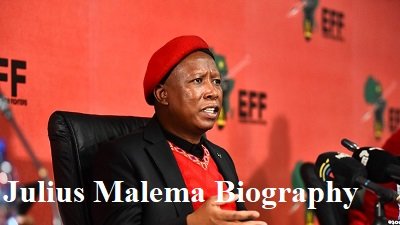
Julius Malema biography: Few politicians in modern South African history have generated as much consistent national attention as Julius Malema. Whether being praised by supporters as a fearless voice for economic transformation or criticized by opponents for inflammatory rhetoric, he has remained a fixture of South African politics for nearly two decades. This is a factual look at how he rose to prominence, the party he built, and where his political and legal journey stands as of 2026.
Julius Malema Age and Early Life
Julius Sello Malema was born on March 3, 1981, in the township of Seshego, near Polokwane, in what was then the Transvaal and is now South Africa’s Limpopo province, making him 45 years old as of 2026. He was raised primarily by his mother, who worked as a domestic worker, and after her passing, by his grandmother, who supported him through much of his upbringing.
Malema joined the African National Congress as a child, reportedly becoming involved with the party’s Masupatsela youth group, sometimes referred to as the Young Pioneers, at around age nine. He joined the ANC Youth League in 1994 and quickly took on local and regional leadership roles. He was also active in the Congress of South African Students, becoming provincial chairman in 1997 before later rising to the organization’s presidency.
He completed his secondary education at Mohlakaneng High School in Seshego. He went on to complete a two-year diploma in youth development through the University of South Africa in 2010, later earning a Bachelor of Arts degree in Communications and African Languages from the same institution in 2016, followed by an Honours degree in Philosophy in 2017. He has also been reported to have enrolled in a master’s program at the University of the Witwatersrand in 2018.
Rise Through the ANC Youth League
In April 2008, Malema was elected president of the ANC Youth League, a result that some accounts describe as having unfolded under contested circumstances. As leader of the Youth League, he became an early and vocal proponent of two policy positions that would go on to define much of his political identity: the nationalization of South Africa’s mining industry and the expropriation of land without compensation.
During this period, Malema rose to national prominence largely through his outspoken support of Jacob Zuma, who was then president of the ANC and later became president of South Africa. His vocal backing of Zuma, including controversial statements expressing willingness to act on Zuma’s behalf, drew significant public attention and criticism.
His tenure as Youth League president was also marked by repeated legal and disciplinary controversy. In 2010, he was found guilty of hate speech in connection with comments he made about a woman who had accused Zuma of rape. He was also convicted by a South African court in 2011 over his public singing of an old liberation-era song containing the phrase “shoot the Boer,” with the court ruling the language constituted hate speech.
His relationship with Zuma eventually deteriorated, leading to a series of ANC disciplinary proceedings against him. In April 2012, Malema was expelled from the African National Congress.
Read also: Olivia Rodrigo Biography: Age, Career, Albums, and Net Worth in 2026
Founding the Economic Freedom Fighters
In June 2013, while still facing trial on money laundering and racketeering charges, Malema began organizing support for a new political movement. Later that July, he announced at a press briefing in Soweto that the new party, the Economic Freedom Fighters, had surpassed the membership threshold required for official registration. The EFF was formally registered with South Africa’s Independent Electoral Commission in September 2013, after an objection to its registration was dismissed.
At the party’s first national elective conference in December 2014, Malema was elected unopposed as president of the EFF, with Floyd Shivambu, who had also been removed from the ANC Youth League alongside him, elected as his deputy. Both men were re-elected unopposed in December 2019.
The EFF describes itself as a communist and black nationalist party, built around a platform of land expropriation without compensation and the nationalization of key industries including mining. In its first general election in 2014, the party won 25 seats in South Africa’s National Assembly, an unusually strong debut for a party formed less than a year earlier. Malema was sworn in as a Member of Parliament on May 21, 2014, and was re-elected to his seat in the 2019 general election, going on to serve on multiple parliamentary portfolio committees.
The EFF placed third nationally in four consecutive general elections between 2014 and 2021. In the 2024 general election, however, the party lost that position to former president Jacob Zuma’s newly formed uMkhonto weSizwe party.
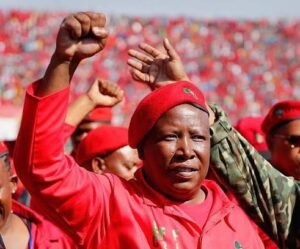
Controversial Public Statements
Malema’s political career has been consistently shadowed by controversial rhetoric, particularly regarding race relations in South Africa. At a political rally in November 2016, he stated that the EFF was not calling for the killing of white people, “at least for now,” a remark that the Democratic Alliance criticized as violent and threatening language. He repeated a similar sentiment in 2022, stating he could not guarantee he would never call for such action in the future.
In 2018, during a separate rally addressing plans to remove a sitting mayor from office, Malema used the phrase “cutting the throat of whiteness” to describe the political maneuver, language that then DA leader Mmusi Maimane publicly labeled as racist.
Following the death of former Zimbabwean president Robert Mugabe in 2019, Malema shared several quotes attributed to Mugabe on social media, including a comment suggesting the only white man who could be trusted was a dead one. The South African Human Rights Commission condemned the post and stated its intention to pursue legal action against him for hate speech. According to one South African Equality Court judge, Malema has at times “called for racists to be killed,” a characterization that has fueled multiple hate speech lawsuits against him over the years, two of which have resulted in guilty findings. Separately, a 2022 court ruling found that the EFF’s continued singing of the older liberation song “Kill the Boer, Kill the Farmer” did not, in that specific instance, constitute hate speech, illustrating how legally contested this area of his public conduct has remained. Julius Malema Biography.
Financial Controversies
Malema’s personal and party finances have faced sustained scrutiny over the years. Reporting has linked his family residence in Hyde Park, Johannesburg, to a controversial cigarette industry businessman, with further reports alleging that associated business figures provided substantial financial contributions and loans connected to Malema and the EFF.
The EFF has also faced allegations tied to South Africa’s VBS Mutual Bank scandal, with investigative reporting alleging that the party, along with senior leadership, including Malema and Shivambu, illicitly received funds linked to the bank’s collapse. These allegations have been the subject of ongoing media investigation and public debate, and Malema has disputed wrongdoing in connection with them.
Firearm Conviction and Imprisonment
Malema’s most serious legal matter to date stems from an EFF demonstration during which he discharged a firearm multiple times on stage in front of a large crowd of supporters. On October 1, 2025, he was convicted on five charges under South Africa’s Firearms Control Act, including unlawful possession of a firearm and ammunition, discharging a weapon in a public or crowded place, and reckless endangerment.
On April 16, 2026, Malema was sentenced to five years in prison in connection with these convictions. He was granted leave to appeal and remains free pending the outcome of that appeal process. Under the South African Constitution, any person sentenced to twelve months or more in prison without the option of a fine, whose conviction is not overturned on appeal, is barred from serving as a Member of Parliament for a period of five years, a provision that places his continued role in Parliament squarely in question, depending on the outcome of his appeal.
Julius Malema Personal Life
Malema married his longtime partner in a private ceremony held under heavy security in his hometown of Seshego in 2014. The couple has two sons together, Munzhedzi, born in 2016, and Kopano, born in 2018. He also has an older son, Ratanang, from a previous relationship with Maropeng Ramohlale.
His grandmother, who played a significant role in raising him after his mother’s passing, died in May 2019.
Julius Malema Net Worth in 2026
Estimates of Malema’s personal net worth vary across sources, with some placing it at over 45 million rand, or roughly 2.5 million US dollars, as of the mid 2020s. Given the ongoing financial scrutiny tied to his political career, any net worth figure attached to him should be treated as an approximation rather than a confirmed amount.
Frequently Asked Questions
How old is Julius Malema? He was born on March 3, 1981, making him 45 years old as of 2026.
What political party does Julius Malema lead? He is the founder and leader of the Economic Freedom Fighters, a party he established in 2013 after his expulsion from the African National Congress.
Why was Julius Malema expelled from the ANC? He was expelled in April 2012 following a series of disciplinary proceedings after his relationship with then ANC president Jacob Zuma deteriorated.
Has Julius Malema been convicted of any crimes? Yes, he has previous hate speech convictions and was convicted in October 2025 on firearm related charges, for which he was sentenced to five years in prison in April 2026, pending appeal.
Is Julius Malema still a Member of Parliament? As of his sentencing in 2026, his continued eligibility to serve in Parliament depends on the outcome of his ongoing appeal, under South African constitutional rules regarding criminal sentencing.
What is the Economic Freedom Fighters’ political platform? The EFF describes itself as a communist and Black nationalist party advocating for land expropriation without compensation and the nationalization of key industries such as mining.
Conclusion
Julius Malema’s career reflects one of the more turbulent and closely watched paths in contemporary South African politics. From a childhood shaped by hardship in Seshego to building and leading a party that consistently placed among the country’s top political forces for over a decade, his story is inseparable from both genuine political influence and sustained legal and ethical controversy. With his firearm conviction now under appeal, the next chapter of his political career remains very much unwritten. Julius Malema biography.