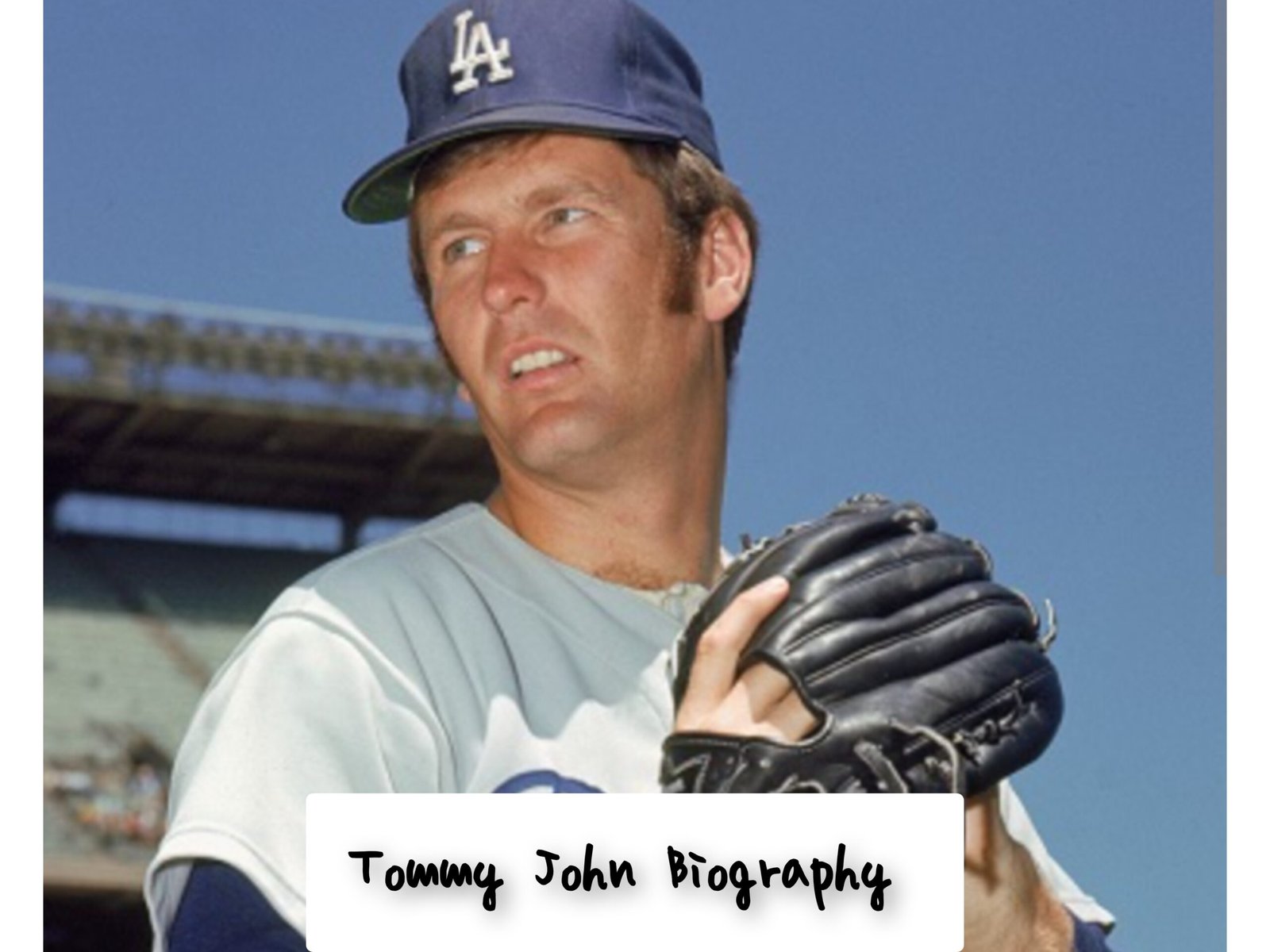
Thomas Edward John Jr. stands as one of the most enduring figures in Major League Baseball history, a left-handed pitcher whose career stretched across 26 seasons and whose name became forever linked to a medical procedure that transformed the sport. Born in the heartland of America and raised amid the basketball-obsessed culture of Indiana, he developed into a precise, intelligent pitcher who relied on movement and location rather than pure velocity. His story blends athletic achievement, medical innovation, personal resilience, and a quiet determination that carried him through injuries that once ended careers.
John’s life and work offer more than statistics or a single famous surgery. He compiled 288 victories, appeared in three World Series, earned four All-Star selections, and pitched effectively into his mid-forties. The procedure performed on his elbow in 1974 by Dr. Frank Jobe gave hope to generations of pitchers and remains one of the most significant advances in sports medicine. This biography traces his path from a Terre Haute backyard to the highest levels of professional baseball, examining the full scope of a career and life marked by longevity, family challenges, and lasting influence.
Tommy John Early Life
Thomas Edward John Jr. was born on May 22, 1943, in Terre Haute, Indiana. He was the second of two children born to Thomas E. John Sr., a lineman for a local utility company, and Ruth Woods John, who managed the household. Terre Haute sits in Vigo County in western Indiana, roughly 70 miles southwest of Indianapolis along the Wabash River. The city’s name, French for “high land,” reflects its elevated position above the river valley. Historically a transportation and manufacturing center, Terre Haute earned the nickname “Crossroads of America” because of its location at the intersection of major highways and rail lines. The region’s economy in the mid-twentieth century relied on coal, clay products, and manufacturing, while its cultural identity leaned heavily toward basketball, the sport that dominates Indiana winters.
Young Tommy grew up in a working-class environment where outdoor play was common. He spent hours at Spencer F. Ball Park and Woodrow Wilson Field, fields that later became part of local youth baseball traditions. His father constructed a simple strike zone from strings in the backyard, inspired by advice in a pitching book by Hall of Famer Bob Feller that Tommy had purchased with money saved from returning empty soda bottles. A family friend, former minor-league pitcher Arley Andrews, taught him the grip and spin for a curveball. These early lessons emphasized control and precision rather than speed, traits that would define his professional style.
At Gerstmeyer High School in Terre Haute, John excelled in both basketball and baseball. Basketball was the preferred sport in Indiana, and he set a city single-game scoring record while earning recruitment interest from major college programs, including the University of Kentucky under legendary coach Adolph Rupp. He graduated as valedictorian of the class of 1961 but did not deliver the commencement speech because of a stutter that affected his public speaking at the time. Despite the basketball opportunities, John recognized that his long-term prospects favored baseball. He signed with the Cleveland Indians organization shortly after high school rather than accepting a college basketball scholarship. He later took classes part-time at Indiana State University in Terre Haute, maintaining ties to his hometown even as professional baseball called.
Indiana’s baseball tradition provided a supportive backdrop. The state had produced major-league talent for decades, and Terre Haute itself hosted professional and semi-professional teams dating back to the nineteenth century. Local fields and organized youth play gave John consistent competition. His decision to pursue baseball full-time reflected both personal assessment and the practical realities of the era, when professional contracts offered immediate opportunities that college basketball could not always match.
Tommy John Career
John’s professional journey began in the Cleveland organization. He progressed quickly through the minor leagues and made his major-league debut on September 6, 1963, at age 20 against the Washington Senators. He appeared in limited action that season and in 1964 before a multi-team trade sent him to the Chicago White Sox prior to the 1965 season.
Time with the Cleveland Indians and Chicago White Sox
With the White Sox from 1965 through 1971, John established himself as a reliable starting pitcher. He posted a combined record of 82 wins and 80 losses with a 2.95 earned-run average over those seven seasons. He led the American League in shutouts in both 1966 and 1967. His sinker and curveball produced ground balls and limited hard contact, allowing him to work deep into games. He started Opening Day for Chicago in 1966, 1970, and 1971. Though the White Sox rarely contended for pennants during his tenure, John gained valuable experience and refined the command that would sustain him for decades.
Years with the Los Angeles Dodgers
Traded to the Los Angeles Dodgers before the 1972 season in exchange for slugger Dick Allen, John entered a more competitive environment. Under pitching coach Red Adams, he further refined his approach, focusing even more on location and movement. From 1972 through the first half of 1974 he compiled a strong record, including a league-leading winning percentage in the injury-shortened 1974 season. On July 17, 1974, while facing the Montreal Expos at Dodger Stadium, he felt a sudden pop in his left elbow after delivering a pitch. The ulnar collateral ligament had torn, an injury that historically ended pitching careers.
The Landmark Surgery and Recovery
Dodgers team physician Dr. Frank Jobe proposed an experimental procedure. On September 25, 1974, Jobe harvested a tendon from John’s right forearm (the non-pitching arm) and used it to reconstruct the damaged ligament in the left elbow. The surgery lasted several hours. A secondary procedure later addressed ulnar-nerve issues. Jobe initially estimated the chance of returning to major-league pitching at roughly one percent. John spent the entire 1975 season rehabilitating, following a careful program that became a model for future recoveries. He returned in 1976, earning National League Comeback Player of the Year honors and the Hutch Award for courage and competitive spirit. That season he made 31 starts and posted a 10-10 record with a 3.09 ERA.
Peak Performance and Later Teams
John’s post-surgery years proved remarkably productive. In 1977 he won 20 games for the Dodgers and finished second in Cy Young Award voting. He helped the team reach the World Series in both 1977 and 1978. After the 1978 season he signed as a free agent with the New York Yankees. There he recorded consecutive 20-win seasons in 1979 and 1980, again finishing high in Cy Young balloting. He started Opening Day for the Yankees multiple times and contributed to their 1981 pennant-winning club.
Later stops included the California Angels from 1982 to 1985 and a brief period with the Oakland Athletics in 1985 before returning to the Yankees for a final stretch from 1986 to 1989. He remained effective into his mid-forties, relying on intelligence and refined mechanics. His final major-league appearance came on May 25, 1989. Across 26 seasons with six teams he finished with 288 wins, 231 losses, a 3.34 ERA, 2,245 strikeouts, 4,710.1 innings pitched, and 700 starts. More than half of his victories (164) came after the 1974 surgery. He appeared in three World Series, posting a strong postseason ERA, though his teams did not win a championship.
John’s longevity ranked among the greatest in modern baseball history. Only a handful of players appeared in as many seasons. His ability to adapt after a once-career-ending injury demonstrated both physical resilience and mental discipline.
Tommy John Awards and Honors
John received recognition throughout his career. He was selected to four All-Star teams (1968 with the White Sox and 1978, 1979, and 1980). He earned the 1976 National League Comeback Player of the Year Award and the Hutch Award the same year. He led the National League in winning percentage in 1974 and captured American League shutout titles in 1966, 1967, and 1980. He finished second in Cy Young Award voting twice and received Most Valuable Player consideration in multiple seasons. Later honors included induction into the Indiana Baseball Hall of Fame in 1996 and recognition as a distinguished alumnus of Indiana State University. Although he never reached the National Baseball Hall of Fame during his time on the writers’ ballot or subsequent committee reviews, his career totals and pioneering role continue to generate discussion among historians and fans.
Tommy John Personal Life
John married Sally Simmons on July 13, 1970. The couple had four children: daughter Tamara and sons Tommy John III, Travis, and Taylor. Family life included both joy and hardship. In August 1981, while John was with the Yankees, two-year-old Travis fell from a third-story window of the family’s New Jersey vacation home, striking a car below. The child spent more than two weeks in a coma but recovered fully and later threw out a ceremonial first pitch. In 2010, son Taylor, who had performed as a child actor and singer on Broadway, died at age 28 following a seizure and heart failure linked to prescription medication. The loss prompted John to found the “Let’s Do It” Foundation, focused on raising awareness about mental health and suicide prevention.
John and Sally Simmons divorced in 2013. In 2021 he married Cheryl Beecher Zeldin. The couple lived in the Lakewood Ranch area of Florida in his later years. Son Tommy John III played college baseball at Furman University and spent time in independent professional leagues before becoming a chiropractor and advocating for safer training practices among young athletes. Daughter Tamara married longtime Chicago Bears long snapper Patrick Mannelly. John maintained close ties to Terre Haute, returning for community events and receiving local honors, including the naming of a baseball diamond at Spencer F. Ball Park in his honor.
After retirement John worked as a broadcaster, minor-league pitching coach, and manager. He managed the Staten Island Yankees in 2004 and later the independent Bridgeport Bluefish. He also became a motivational speaker, sharing lessons from his career and personal experiences. He authored books reflecting on his baseball life and family. In his final years he faced health challenges, including a serious bout with COVID-19 and a recurrence of bladder cancer. He died peacefully on August 15, 2026, at his home in Lakewood Ranch, Florida, at the age of 83, surrounded by family.
Tommy John Legacy in Baseball Medicine
The surgery that bears John’s name changed how organizations and athletes approach elbow injuries. Before 1974, a torn ulnar collateral ligament usually meant the end of a pitching career. The reconstruction technique, refined over decades, has been performed on hundreds of professional and amateur players. Success rates improved as surgeons advanced methods for nerve protection, graft placement, and rehabilitation. John himself later expressed concern about the procedure’s increasing use among teenagers who throw at high velocities from a young age, arguing that better mechanics and workload management should come first. His willingness to undergo the experimental operation in 1974 opened a path that many others have followed, extending careers and preserving talent that would otherwise have been lost.
Tommy John Connection to Indiana and Terre Haute
John never forgot his roots. Terre Haute’s combination of industrial work ethic, community sports, and Midwestern values shaped his approach to preparation and perseverance. Local fields where he first learned control later hosted youth leagues and community events. The city’s baseball history, which includes earlier major-league figures and professional teams in the Three-I League and other circuits, provided context for his success. Indiana State University and local high school programs continued to claim him as one of their own. When he returned for public appearances, he often reminded audiences that the fundamentals he used in the major leagues were first practiced on Terre Haute diamonds. His father’s advice, offered as John left for his first professional assignment, stayed with him: no matter the level of success, he would always be Tommy John from Terre Haute, Indiana.
Conclusion
Thomas Edward John Jr. lived a life defined by consistency, courage, and quiet innovation. From the backyard strings of a Terre Haute childhood to 26 seasons in Major League Baseball, he demonstrated that precision and determination can outlast raw power. The surgery that saved his career became a standard of care that has benefited countless athletes. His statistical achievements place him among the most durable pitchers of the modern era, while his personal challenges and advocacy work revealed a deeper commitment to family and community. Though debates about Hall of Fame recognition continue, his influence on the game is already secure. John showed that an injury once considered final could become a new beginning, and that a pitcher from a mid-sized Indiana city could leave a permanent mark on baseball history.
FAQs
What was Tommy John’s full name and where was he born?
Thomas Edward John Jr. was born in Terre Haute, Indiana, on May 22, 1943.
How many wins did Tommy John record in his career?
He finished with 288 major-league victories against 231 losses.
When and why did Tommy John undergo the surgery named after him?
In September 1974, after tearing the ulnar collateral ligament in his left elbow during a game in July of that year, he underwent reconstructive surgery performed by Dr. Frank Jobe.
Did Tommy John win a World Series?
No. He appeared in three World Series with the Dodgers and Yankees but was on the losing side each time.
How long did Tommy John pitch after his surgery?
He returned in 1976 and continued pitching until 1989, winning 164 games after the procedure.
Was Tommy John elected to the Baseball Hall of Fame?
He was not elected during his 15 years on the writers’ ballot or in subsequent committee considerations, though his case continues to be discussed.
What teams did Tommy John play for?
He pitched for the Cleveland Indians, Chicago White Sox, Los Angeles Dodgers, New York Yankees, California Angels, and Oakland Athletics.
What personal challenges did Tommy John face off the field?
His family experienced a serious accident involving one son in 1981 and the death of another son in 2010. He later founded a foundation focused on mental-health awareness and suicide prevention.
Where did Tommy John live in later years and when did he die?
He lived in the Lakewood Ranch area of Florida and died there on August 15, 2026, at age 83.
Why is Tommy John still important to baseball today?
The reconstructive elbow procedure named after him has allowed hundreds of pitchers to resume their careers, fundamentally changing injury management in the sport.