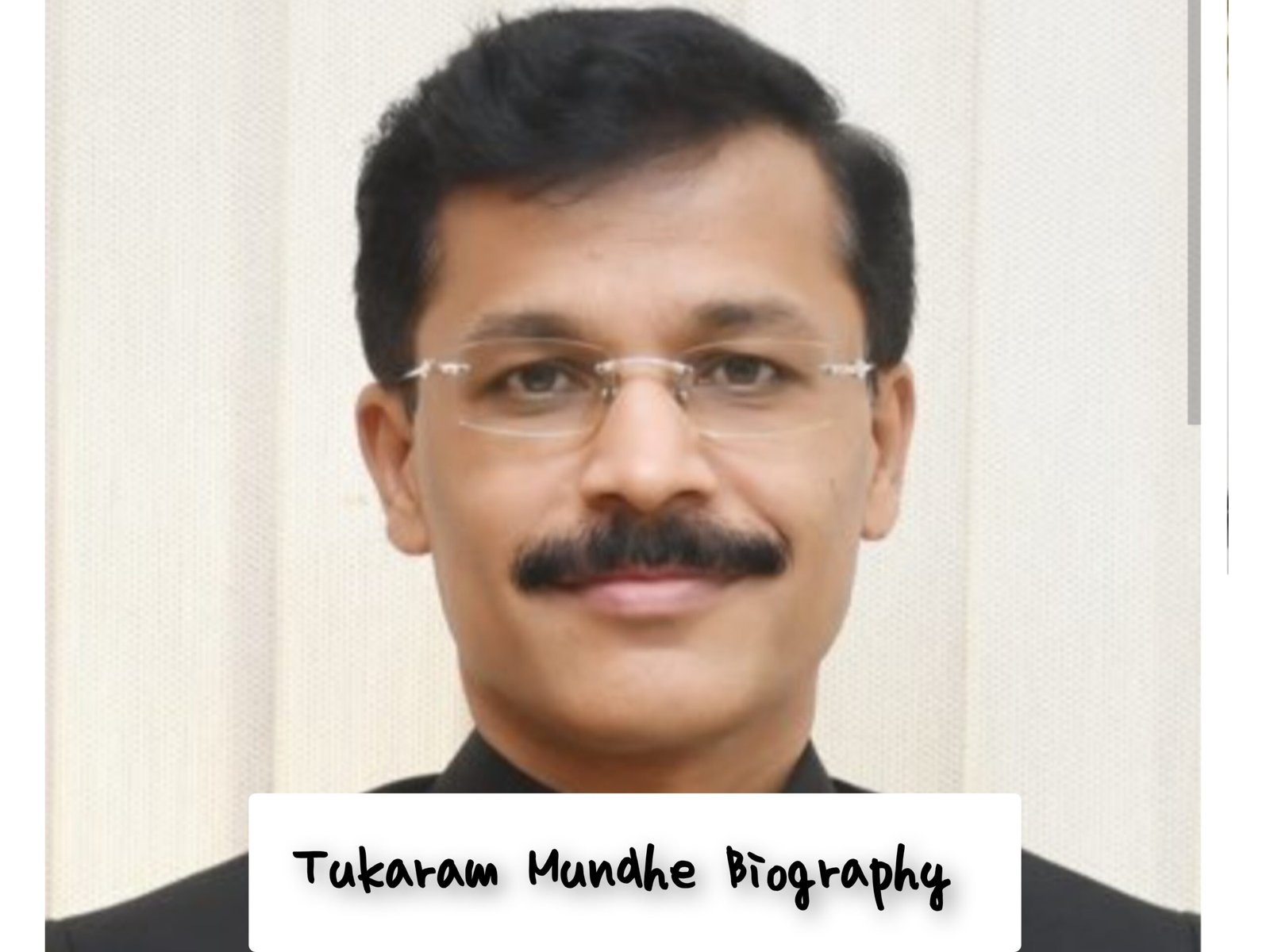
Tukaram Haribhau Mundhe is an Indian Administrative Service officer of the 2005 batch belonging to the Maharashtra cadre. Born in a small farming village in the drought prone Beed district of Maharashtra, he has built a public reputation for firm enforcement of rules, hands on administration and a style of work that often places him at the centre of both public praise and administrative friction.
His career spans more than two decades of service across district administration, municipal corporations, transport, health and regulatory bodies. As of 2026 he serves as Commissioner of the Maharashtra Food and Drug Administration, where his statewide drives against food adulteration and unsafe products have drawn wide attention. This biography presents the verified facts of his life, education, postings and public work in clear chronological order.
Tukaram Mundhe Early Life
Tukaram Haribhau Mundhe was born on 3 June 1975 in Tadsonna village of Beed district in the Marathwada region of Maharashtra. He belongs to an Indian farming family of the Vanjari community, which is listed under the Other Backward Classes category in the state. His father, Haribhau Mundhe, worked as a marginal farmer. His mother, Asarabai Mundhe (also referred to in some accounts as Aasrabai), managed the household under difficult financial conditions. The family lived in a mud brick house and depended almost entirely on agriculture and the sale of farm produce.
Beed district lies in the rain shadow area of Marathwada, a region long marked by uncertain monsoon rains, recurrent drought and agricultural distress. Water scarcity shaped daily life. Young Tukaram helped his parents on the family farm before and after school. He watered crops by hand, often waking in the middle of the night when electricity returned after long power cuts. He also accompanied his parents to the weekly market to sell vegetables. These routines left little time for play. School and farm work occupied most of his day.
He attended a Zilla Parishad school in Beed. The school was a basic government institution typical of rural Maharashtra at the time. Walking barefoot to school was common. Despite the hardships, he remained focused on studies. Family accounts describe a disciplined routine that combined manual labour with classroom learning. Agricultural debt and the failure of government welfare schemes to reach ordinary farming households were part of the environment in which he grew up. These experiences later informed his stated reason for entering public service: to work inside the system rather than remain outside it.
After completing secondary education he moved to Aurangabad, then known as Aurangabad and now Chhatrapati Sambhajinagar, for higher studies. The shift from a village to a city environment brought new experiences. He completed his graduation from the Government College of Arts and Science in 1996, studying subjects that included History, Political Science and Sociology. In 1998 he earned a Master of Arts degree in Political Science from Dr Babasaheb Ambedkar Marathwada University. The academic foundation in political science and related social sciences prepared him for the competitive examinations that would follow.
Tukaram Mundhe Education and Entry into Civil Services
Preparation for the Union Public Service Commission Civil Services Examination began while he continued postgraduate studies. He had no access to expensive coaching institutes or family networks in the bureaucracy. Early attempts between 1997 and 2000 did not succeed. During this period his father suffered a paralytic attack, adding further strain on the family. Mundhe qualified the Maharashtra Public Service Commission examination in 2001 and received a Class II post in the state finance department. The joining process was delayed, so he taught for a short time at a private college and later held a contractual lectureship at Ismail Yusuf College in Mumbai until 2003.
He returned to full time preparation for the UPSC examination. In his final attempt in 2004 he secured an All India Rank of 20. He joined the Indian Administrative Service in the 2005 batch and was allotted his home cadre of Maharashtra. The success of a student from a Zilla Parishad school and a farming family in Beed was noted in rural Maharashtra as an example of determination and sustained effort.
After joining the service he continued professional education. He completed training programmes in leadership, financial market regulation, tax analysis and revenue forecasting, fiscal policy and macroeconomic management, and disaster management. These courses reflected an interest in fiscal and regulatory aspects of administration that later appeared in several of his postings.
Tukaram Mundhe Career
Mundhe’s career has been marked by a wide range of responsibilities and an unusually high number of transfers. Public reports place the figure at approximately 25 transfers over 21 years of service. He has never completed a full standard tenure of about three years in any single posting. Supporters view the frequent moves as the price of an uncompromising approach. Critics sometimes describe the same record as evidence of an inflexible style that creates friction with elected representatives and vested interests. Mundhe himself has stated that change is part of progress and that each new assignment offers fresh opportunities for positive work.
Early Field Postings
His first field assignment after training was as Assistant Collector in Deglur, Nanded district. In a short period he focused on water quality, pending public grievances and action against illegal sand mining. The measures against the sand mafia brought death threats and the provision of additional police security. Subsequent early postings included roles as Chief Executive Officer of Zilla Parishad in different districts, Additional Tribal Commissioner in Nashik, and Collector of Jalna. In these assignments he emphasised attendance of teachers and doctors, reduction of absenteeism, and stricter implementation of development schemes. Institutional deliveries in hospitals under his charge showed measurable improvement in one posting. He also worked as Joint Commissioner of Sales Tax (Investigation) in Mumbai for more than two years, a comparatively longer stint, during which tax recovery exceeded annual targets by a substantial margin.
District Collector of Solapur
In 2014 Mundhe took charge as District Collector of Solapur, a drought prone district that relied heavily on water tankers. He concentrated on the Jalyukt Shivar water conservation programme launched by the state government. The approach rested on three principles: treatment of the catchment area, treatment of drained land, and scientific use of available water. Local participation was encouraged through incentives linked to actual work completed. Within months the administration reported large scale compartmental bunding, recharging of tens of thousands of wells, and a sharp drop in the number of tankers required. By later years the district recorded periods with no tanker deployment at all. Mining revenue increased and crop loan disbursement rose. For overall performance he received the Maharashtra government’s Best District Collector Award for 2015-16. The work earned him the popular description “Water Man of Maharashtra.”
Municipal Commissioner Roles
As Municipal Commissioner of Navi Mumbai he introduced early morning “Walk with the Commissioner” inspections so that citizens could raise issues directly. He acted against unauthorised constructions and hoardings, improved property tax recovery, and cancelled certain large projects he considered unnecessary, redirecting funds toward accessibility for persons with disabilities and basic civic infrastructure. The Navi Mumbai Municipal Corporation received recognition for e-toilets and seismic retrofitting work during this period. Corporators later passed a no-confidence motion, citing differences over decision making style. A citizen petition supporting him gathered thousands of signatures, yet he was transferred.
He later served as Municipal Commissioner in Nashik and briefly in Nagpur. In each place he pursued transparency measures, tighter control over expenditure, and enforcement against irregular practices. These postings again produced both public support and political pushback. At Pune Mahanagar Parivahan Mahamandal Limited he addressed chronic absenteeism among contract drivers, resulting in the termination of a large number of employees. The decision triggered union and political reaction.
Later State Level Assignments
Subsequent roles included positions in health administration, where he ordered midnight inspections of primary health centres and linked attendance to biometric systems. He also held secretary level posts in departments dealing with disaster management, revenue, unorganised labour and welfare of persons with disabilities. In May 2026 he assumed charge as Commissioner of the Maharashtra Food and Drug Administration.
Leadership of the Food and Drug Administration
As FDA Commissioner he launched a statewide enforcement campaign focused on food safety, hygiene standards, licensing and the sale of banned products such as gutkha and certain pan masala brands. Raids covered restaurants, dairies, manufacturers, wholesalers and retailers. Large quantities of adulterated or suspect food stock were seized. Notices were issued to public figures associated with advertisements for products banned in the state. An artificial intelligence enabled grievance portal was introduced to allow citizens to report adulteration and substandard medicines through voice based complaints. The drive has been praised by consumers and public health advocates while drawing criticism from sections of the hospitality industry and occasional judicial observations urging proportional action.
Tukaram Mundhe Awards and Recognition
Mundhe has received several official recognitions for administrative performance. The Maharashtra government awarded him the Best District Collector Award for 2015-16 for all round excellence in Solapur. He was publicly acknowledged as the Water Man of Maharashtra for water conservation results under the Jalyukt Shivar programme. The Indian Express Excellence in Governance Award recognised work done by district magistrates across the country. Additional distinctions include a National Award for Social Justice and Empowerment from the Union Ministry of Social Justice and Empowerment, the SKOCH Order of Merit for initiatives of the Navi Mumbai Municipal Corporation, and a National Award for the Best Integrated Traffic Management System in 2017. These awards reflect documented outcomes in water management, urban governance, public health and social inclusion.
Tukaram Mundhe Approach to Administration
Throughout his career Mundhe has articulated a simple decision making framework: every action should be legal, morally correct and in the public interest. He has stated that if any two of these conditions are satisfied, including legality, he proceeds without hesitation. This approach has guided actions against illegal sand mining, unauthorised constructions, tax evasion, teacher and doctor absenteeism, and food adulteration. It has also produced friction with elected bodies and commercial interests that benefit from slower or more negotiated enforcement. Public support has frequently appeared in the form of citizen petitions and social media appreciation, while formal political responses have often taken the shape of no-confidence motions or rapid transfers.
Tukaram Mundhe Personal Life
Tukaram Mundhe married Archana Mundhe in 2009. The couple has one son, Agastya Mundhe, and one daughter, Ashana Mundhe. Family life has remained largely private. His elder brother, Ashok Mundhe, has also served in administrative roles. Mundhe has spoken of the influence of his parents’ hard work and of the discipline formed during childhood years spent between the farm and the school. He continues to maintain a public presence through official communications related to his current responsibilities rather than through personal publicity.
Tukaram Mundhe Roots in Beed and Marathwada
Understanding Mundhe’s background requires attention to the geography and economy of Beed district. Located in the Marathwada division of Maharashtra, Beed forms part of a historically underdeveloped region that experiences frequent drought. Agriculture depends heavily on the monsoon. Groundwater levels fluctuate sharply. Many villages rely on tankers during dry months. Educational and health infrastructure in rural pockets has improved over decades yet still lags behind more prosperous districts of western Maharashtra. Growing up in this setting gave Mundhe direct experience of the gap between government schemes and their delivery on the ground. That experience is repeatedly cited by him as the reason he chose the civil services rather than remaining outside the system.
Conclusion
Tukaram Haribhau Mundhe’s journey from a farming household in Tadsonna village to senior positions in the Maharashtra administration illustrates the possibilities open to determined students from rural backgrounds. His record shows consistent emphasis on rule based enforcement, measurable outcomes in water conservation and civic management, and a willingness to accept frequent transfers as part of the cost of that approach. As Commissioner of the Food and Drug Administration he continues to apply the same standards to food safety and public health regulation. The verified facts of his education, postings and awards provide a clear picture of an officer shaped by the realities of Marathwada and committed to translating those lessons into administrative action.
FAQs
Who is Tukaram Mundhe?
Tukaram Haribhau Mundhe is a 2005 batch Indian Administrative Service officer of the Maharashtra cadre currently serving as Commissioner of the Maharashtra Food and Drug Administration.
When and where was Tukaram Mundhe born?
He was born on 3 June 1975 in Tadsonna village of Beed district in Maharashtra, India.
What is Tukaram Mundhe’s educational background?
He studied at a Zilla Parishad school in Beed, completed graduation from the Government College of Arts and Science in Aurangabad in 1996, and earned a Master of Arts in Political Science from Dr Babasaheb Ambedkar Marathwada University in 1998.
How did Tukaram Mundhe enter the IAS?
He cleared the UPSC Civil Services Examination in 2004 with an All India Rank of 20 and joined the Indian Administrative Service in the 2005 batch.
Why is Tukaram Mundhe called the Water Man of Maharashtra?
The title refers to his work as District Collector of Solapur under the Jalyukt Shivar programme, which reduced dependence on water tankers in many villages through systematic conservation measures.
How many times has Tukaram Mundhe been transferred?
Public reports indicate approximately 25 transfers over 21 years of service.
What awards has Tukaram Mundhe received?
He received the Maharashtra government’s Best District Collector Award for 2015-16, recognition as Water Man of Maharashtra, the Indian Express Excellence in Governance Award, a National Award for Social Justice and Empowerment, and other distinctions related to urban governance and traffic management.
Is Tukaram Mundhe married?
Yes. He married Archana Mundhe in 2009. They have a son and a daughter.
What is Tukaram Mundhe’s current posting?
As of 2026 he is the Commissioner of the Maharashtra Food and Drug Administration.
Which community does Tukaram Mundhe belong to?
He belongs to the Vanjari community, which is categorised under the Other Backward Classes in Maharashtra.