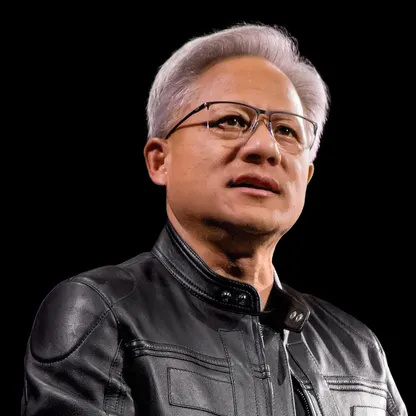
Jensen Huang has spent the last few years as one of the most talked-about executives in tech, mostly because of Nvidia’s rise to becoming the backbone of the AI industry. Lately though, he’s trending for something a little different: predicting that some of the best-paying jobs of the AI era won’t be in coding at all, but in construction and the skilled trades.
Here’s a full look at who Jensen Huang is, how he built Nvidia into a multitrillion-dollar company, and what exactly he’s been saying about the future of blue-collar work.
Who Is Jensen Huang?
Jensen Huang is a Taiwanese American businessman and electrical engineer who co-founded the chip company Nvidia in 1993 and has served as its CEO ever since. Under his leadership, Nvidia went from a niche maker of gaming graphics cards to the company whose processors now power much of the world’s artificial intelligence infrastructure.
By 2025, Nvidia had become one of the most valuable companies on the planet, crossing a $4 trillion market capitalization that year and later climbing past $5 trillion. Huang’s personal stake in the company, combined with that growth, has made him one of the wealthiest people alive.
How Old Is Jensen Huang?
Huang was born on February 17, 1963, in Tainan, Taiwan. That makes him 63 years old as of 2026.
Early Life
Huang’s early years were far from a straight line to Silicon Valley. His family first moved from Taiwan to Thailand when he was about five years old. At nine, he and his older brother were sent to live with an uncle in Tacoma, Washington, and Huang ended up attending Oneida Baptist Institute, a religious boarding school in rural Kentucky, believing at the time he was heading to a more traditional prep school.
Those years instilled a strong sense of self-reliance in him early on. He also became a serious table tennis player during that period, eventually earning a national ranking in doubles as a teenager.
Huang went on to earn a bachelor’s degree in electrical engineering from Oregon State University in 1984, and later completed a master’s degree in electrical engineering at Stanford University in 1992. Before starting Nvidia, he worked as an engineer at chip companies Advanced Micro Devices and LSI Logic.
Founding Nvidia
In 1993, at the age of 30, Huang co-founded Nvidia along with Chris Malachowsky and Curtis Priem. According to company lore, the trio settled on the company’s direction during a conversation at a Denny’s restaurant in San Jose. Huang was chosen to lead the company as CEO, a role he has held for more than three decades since.
Nvidia’s early years were built around graphics processing for video games, and the company found real momentum with the 1999 launch of the GeForce 256, often credited as the first modern GPU. But the decision that eventually reshaped the entire company came in 2006, when Huang pushed Nvidia to invest heavily in CUDA, a computing platform that let Nvidia’s chips be used for far more than graphics. It was a costly, multibillion-dollar bet that took years to pay off and drew plenty of skepticism from investors along the way.
The AI Boom and Nvidia’s Rise
That early investment in CUDA turned out to be one of the more consequential bets in modern tech history. As artificial intelligence models grew more powerful through the 2010s and into the 2020s, it became clear that Nvidia’s chips were uniquely suited to training and running them. Demand exploded, and Nvidia quickly became the default hardware provider behind the AI systems built by companies across the industry.
By 2025, Nvidia’s market value had soared past $4 trillion, making it the most valuable public company in the world at the time, and it continued climbing from there. Huang, as co-founder and one of the company’s largest individual shareholders, saw his personal fortune grow right alongside it.
Jensen Huang’s Net Worth
Huang’s net worth has moved dramatically over the past several years as Nvidia’s stock has surged. As of 2026, estimates from financial outlets generally place his fortune somewhere between $150 billion and over $200 billion, driven almost entirely by his roughly 3.5 to 3.8 percent ownership stake in Nvidia. That range puts him among the handful of wealthiest people in the world.
It’s worth noting that these figures move constantly with Nvidia’s stock price, so any specific number is really a snapshot rather than a fixed amount. Huang has also sold a portion of his shares over the past couple of years through a prearranged trading plan, a common practice among executives with large equity stakes.
Jensen Huang’s Construction Careers Forecast
The story putting Huang back in the headlines right now isn’t about chips at all. It’s about plumbers and electricians.
Speaking at the World Economic Forum in Davos in January 2026, Huang argued that the AI boom is going to create a wave of high-paying jobs in construction and the skilled trades, not just in software engineering. His reasoning is straightforward: building the data centers, chip factories, and power infrastructure needed to support AI requires physical labor that can’t be automated away. He’s since repeated the message at other public appearances, including Carnegie Mellon University’s 2026 commencement, where he told graduates, “Electricians, plumbers, iron workers, technicians, builders, this is your time.”
Huang has pointed to roughly $7 trillion in global AI infrastructure spending expected by 2030, covering data centers, semiconductor plants, and the energy systems needed to power them. According to a McKinsey estimate cited alongside his comments, the United States alone may need around 130,000 additional electricians, 240,000 construction laborers, and 150,000 construction supervisors by the end of the decade. Many of those roles already pay well over $100,000 a year and typically don’t require a four-year college degree.
He’s not the only executive making this argument. Ford CEO Jim Farley and BlackRock CEO Larry Fink have both raised similar concerns about labor shortages in construction and skilled trades tied to the broader AI buildout, with Fink specifically warning that the country could run short of electricians needed to build AI data centers.
Why the Message Is Resonating
Huang’s comments have landed at a moment when a lot of younger workers, particularly recent college graduates, are anxious about how AI might affect white-collar hiring. His pitch flips that anxiety around: instead of positioning AI as a threat to entry-level jobs, he’s framing the physical buildout behind AI as a source of stable, well-paying work that doesn’t require a traditional degree path. Apprenticeship programs in trades like electrical work typically offer paid, on-the-job training over four to five years, which Huang and others have pointed to as a faster and cheaper route into a solid career than a conventional four-year degree.
Industry data backs up at least part of the argument. The U.S. Bureau of Labor Statistics projects construction and extraction jobs will grow faster than the overall job market through the next decade, and data center construction spending alone is forecast to keep climbing through 2026.
Jensen Huang’s path from a Kentucky boarding school and a table tennis ranking to running one of the most valuable companies in the world is already a remarkable story on its own. But his latest comments show he’s just as focused on where the next generation of workers will find opportunity as he is on Nvidia’s own growth. Whether the trades boom he’s describing holds up over the next few years will depend a lot on how long the current wave of AI infrastructure spending continues, but for now, it’s clearly a message a lot of people are paying attention to.
Frequently Asked Questions
1. How old is Jensen Huang? He was born on February 17, 1963, making him 63 years old as of 2026.
2. What company does Jensen Huang run? He is the co-founder and CEO of Nvidia, a role he has held since founding the company in 1993.
3. What is Jensen Huang’s net worth? Estimates as of 2026 generally place his net worth between $150 billion and over $200 billion, based largely on his ownership stake in Nvidia.
4. What did Jensen Huang say about construction jobs? He said the AI infrastructure boom will create large numbers of high-paying jobs for electricians, plumbers, and construction workers, arguing these roles can’t easily be automated.
5. Where did Jensen Huang say this? He first made the comments at the World Economic Forum in Davos in January 2026 and repeated the message at Carnegie Mellon University’s commencement in May 2026.
6. Do these construction jobs really pay six figures? Many specialized trade roles, including industrial electricians and experienced construction supervisors, already pay over $100,000 a year according to industry data cited alongside Huang’s comments.
7. Where was Jensen Huang born? He was born in Tainan, Taiwan, and moved to the United States at around age nine.
8. What is Jensen Huang’s educational background? He earned a bachelor’s degree in electrical engineering from Oregon State University and a master’s degree in electrical engineering from Stanford University.
9. When did Nvidia become so valuable? Nvidia’s market capitalization passed $4 trillion in 2025 and continued climbing past $5 trillion, largely driven by demand for AI computing hardware.
10. Are other executives making similar predictions about trade jobs? Yes, Ford CEO Jim Farley and BlackRock CEO Larry Fink have both pointed to labor shortages in construction and skilled trades tied to AI infrastructure growth.