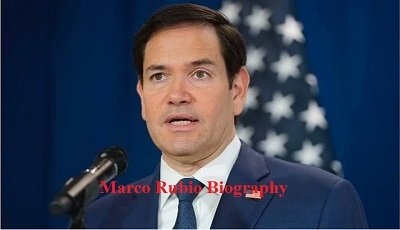
Marco Rubio biography: Marco Rubio’s career traces a path that few American politicians have followed quite as closely, from the son of Cuban immigrant hotel and bar workers in Miami to the Speaker of the Florida House, a United States Senator, a nationally known presidential candidate, and eventually the country’s chief diplomat. His current role places him at the center of some of the most consequential foreign policy decisions facing the United States, making his background and rise worth understanding in full.
Marco Rubio Age and Early Life
Marco Antonio Rubio was born on May 28, 1971, in Miami, Florida, making him 55 years old as of 2026. He is the son of Cuban immigrants, Mario Rubio and Oriales Garcia, who left Cuba in 1956 in search of greater opportunity in the United States. His father worked as a banquet bartender, while his mother divided her time between working as a hotel maid and being a stay at home parent. Rubio has often spoken about how this upbringing shaped his political outlook, describing the experience as a direct example of what he calls the American Dream.
He has also credited his grandfather, who witnessed firsthand the effects of communism on Cuba, as a significant early influence that drew him toward public service. Rubio earned a bachelor’s degree from the University of Florida before going on to complete a law degree at the University of Miami School of Law.
Early Political Career in Florida
Rubio’s political career began at the local level, serving as a City Commissioner in West Miami. He was elected to the Florida House of Representatives in 2000, where he went on to serve as Majority Leader from 2003 to 2006 before being elected Speaker of the Florida House, a position he held from 2006 to 2008.
In 2009, Rubio announced his candidacy for the United States Senate seat that had been vacated following Mel Martinez’s resignation. Despite initially trailing the incumbent Republican Governor Charlie Crist in early polling, Rubio gained substantial support within his party after Crist chose to run as an independent candidate instead. Rubio went on to win the 2010 Senate election, representing Florida in the United States Senate beginning in January 2011. He was subsequently reelected in 2016 and again in 2022, making him, by 2026, the longest serving Republican senator in Florida’s history at the time of his departure from the chamber.
Read also: Benjamin Netanyahu Biography: Age, Political Career, and Current Legal Proceedings in 2026
The 2016 Presidential Campaign
In 2016, Rubio sought the Republican nomination for President of the United States. His campaign platform emphasized a balanced federal budget, the repeal of the Affordable Care Act, broader tax reform, and increased border security. He emerged early in the primary season as a candidate favored by parts of the Republican establishment, but his campaign struggled as voting progressed, winning primary contests only in Minnesota, the District of Columbia, and Puerto Rico.
The campaign was also notable for a sharp and very public rivalry with fellow candidate Donald Trump, who repeatedly referred to Rubio using the nickname Little Marco, while Rubio at one point described Trump as the most vulgar person ever to seek the presidency. After a loss in the Florida primary in March 2016, Rubio suspended his presidential campaign. Rather than leaving politics altogether, he chose to seek reelection to his Senate seat later that year and won.
Senate Career and Foreign Policy Focus
During his time in the Senate, Rubio became a prominent voice on foreign policy matters, serving as a senior member of the Senate Foreign Relations Committee and as vice chairman of the Senate Select Committee on Intelligence. He authored bipartisan legislation focused on China, including measures aimed at holding the Chinese government accountable for human rights concerns involving Uyghur Muslims and the situation in Hong Kong.
Rubio also became one of the Senate’s most consistent voices on Latin American policy, sponsoring legislation that called for sanctions against individuals responsible for human rights abuses in Venezuela and becoming a vocal and longstanding critic of Venezuelan President Nicolas Maduro. His Cuban family background has informed much of his approach to the region throughout his career, including a consistent focus on Cuba’s communist government.
From Rival to Secretary of State
Despite their bitter rivalry during the 2016 Republican primary, Rubio’s relationship with Donald Trump shifted considerably in the years that followed. In November 2024, President-elect Trump announced his intention to nominate Rubio as Secretary of State for his second administration. Rubio’s confirmation hearing took place before the Senate Foreign Relations Committee in January 2025, where he stated that the United States Department of State’s top priority under his leadership would be centered on American national interests.
Rubio was confirmed by the United States Senate in a unanimous vote of 99 to 0, becoming the first cabinet member confirmed in the second Trump administration. He was sworn in as the 72nd United States Secretary of State on January 21, 2025, becoming the first Latino American to hold the position and, by extension, the highest ranking Hispanic American official in the country’s history.
Expanding Responsibilities
Rubio’s role within the Trump administration grew substantially beyond the State Department over the course of 2025. On May 1, 2025, President Trump announced that Rubio would also serve as acting National Security Advisor, replacing Mike Waltz, while continuing to hold his position as Secretary of State simultaneously. This combination of roles had previously only been held by Henry Kissinger during the Nixon and Ford administrations in the 1970s.
Rubio additionally took on the role of acting Administrator of the United States Agency for International Development beginning in February 2025, a position he held until August 2025. He also became acting Archivist of the United States in February 2025, following the removal of the previous archivist, a role he held until February 2026, when he stepped down from it in order to comply with federal vacancy regulations, with authority subsequently delegated to his senior advisor.
Key Foreign Policy Positions in 2026
As Secretary of State, Rubio has been at the center of several major and often contentious foreign policy developments. In February 2025, he expressed support for a proposal regarding the United States taking a role in Gaza, stating that the country stood ready to lead toward what he described as a lasting peace for all people in the region. Rubio has stated his openness to cooperation with China on shared global challenges, while acknowledging what he described as ongoing irritants in the relationship between the two countries.
Cuba and Venezuela have remained consistent areas of focus for Rubio in his current role, consistent with his decades long interest in the region. In May 2026, he announced new sanctions targeting Grupo de Administracion Empresarial, a Cuban military controlled business conglomerate that Rubio has described as the central pillar of Cuba’s communist economic system. He has continued to serve as a leading administration voice regarding pressure on the Maduro government in Venezuela as well, including statements regarding humanitarian assistance to the country in mid-2026.
Rubio has also played a central diplomatic role in the Middle East throughout 2026, including helping facilitate a framework agreement between Israel and Lebanon described as an initial step toward a broader peace arrangement, and engaging with Gulf Arab nations regarding their concerns over an emerging agreement with Iran. Foreign policy observers have offered varying assessments of his influence within the administration’s broader regional decision making, reflecting the genuinely high stakes and contested nature of US policy in the region during this period.
Personal Life
Rubio is Catholic and has spoken about the role his faith has played throughout his life and career. He is married to Jeanette Dousdebes Rubio, and the couple has four children together.
Frequently Asked Questions
How old is Marco Rubio? He was born on May 28, 1971, making him 55 years old as of 2026.
What position does Marco Rubio currently hold? He serves as the 72nd United States Secretary of State, a position he has held since January 2025, and has also served as acting National Security Advisor since May 2025.
Is Marco Rubio the first Latino Secretary of State? Yes, he is the first Latino American to serve as US Secretary of State, making him the highest ranking Hispanic American official in US history.
Did Marco Rubio run for president? Yes, he ran unsuccessfully for the Republican presidential nomination in 2016, ultimately suspending his campaign after a loss in the Florida primary.
What did Marco Rubio do before becoming Secretary of State? He served as a United States Senator representing Florida from 2011 to 2025, and before that, as Speaker of the Florida House of Representatives.
Is Marco Rubio married? Yes, he is married to Jeanette Rubio, and the couple has four children.
Conclusion
Marco Rubio’s career reflects a long and steady climb through American political life, built on a consistent focus on foreign policy and a personal connection to Cuban and broader Latin American affairs shaped by his family’s own immigrant story. From local office in Miami to the Senate, a national presidential campaign, and now one of the most powerful foreign policy roles in the United States government, his trajectory illustrates how a single career can move through nearly every major level of American public service. With significant foreign policy decisions continuing to unfold across multiple regions in 2026, his current role remains one of the most closely watched in American government.