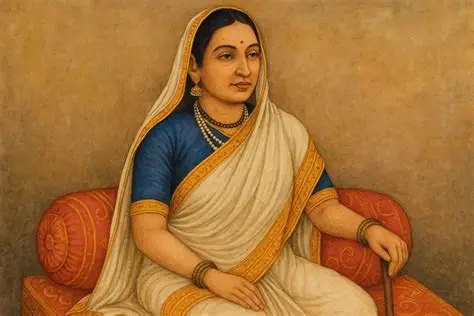
Ahilyabai Holkar was an 18th-century Indian ruler who governed the Malwa region and became one of the most respected women in Indian history. She was known for her effective administration, commitment to public welfare, support for trade and artisans, and extensive contribution to the development and restoration of religious and public sites.
She was born on May 31, 1725, in Chondi, a village in present-day Maharashtra. Her father, Mankoji Rao Shinde, was the village headman, and he ensured that Ahilyabai received an education at a time when formal learning was not commonly available to girls from ordinary families.
Her life changed when Malhar Rao Holkar, a powerful Maratha military leader, noticed her as a young girl. Ahilyabai later married his son, Khanderao Holkar, and became part of the influential Holkar family.
Her path to the throne was shaped by several painful losses. Her husband died during a military campaign in 1754, while her father-in-law died in 1766. Her only son, Male Rao, also died in 1767. Following these events, Ahilyabai took responsibility for the Holkar state and began her reign.
She ruled for almost three decades, making Maheshwar the centre of her administration. Under her leadership, the city developed as a hub for culture, commerce, religious activity and textile production.
Ahilyabai was also a major patron of architecture and public infrastructure. Her influence reached beyond Malwa, with her name associated with temples, ghats, wells, roads, rest houses and other projects across several parts of India.
Her historical importance comes from more than her position as a female ruler. She earned lasting respect because of the way she governed and the long-term impact of the projects undertaken during her reign.
Ahilyabai Holkar Early Life, Husband and Family
Table of Contents
ToggleAhilyabai Holkar was born on May 31, 1725, in Chondi, in the present-day Ahilyanagar district of Maharashtra. She was the daughter of Mankoji Rao Shinde and Sushilabai, and her family lived a relatively modest life compared with the royal household she would later join.
Her father served as the village headman and played an important role in her early education. Ahilyabai learned to read and write, which was unusual for girls in many communities during the 18th century. Her education later helped her handle administrative responsibilities and communicate directly with officials and subjects.
According to historical accounts, Malhar Rao Holkar encountered Ahilyabai when she was young and was impressed by her character. He eventually arranged her marriage to his son, Khanderao Holkar. Through this marriage, she entered the Holkar household and became connected to one of the most influential Maratha families of the period.
Khanderao served as a military commander and participated in several campaigns. His death in 1754 was a devastating event for Ahilyabai. Historical accounts state that she considered following the practice of sati after his death, but Malhar Rao Holkar intervened and encouraged her to continue living and serving the family.
Malhar Rao subsequently gave Ahilyabai greater exposure to government affairs. Rather than remaining away from political matters, she became familiar with administration, military issues and the responsibilities of governing a territory.
Her family suffered another major loss when Malhar Rao died in 1766. His death left the Holker state facing a difficult succession situation.
Ahilyabai’s son, Male Rao, became ruler after Malhar Rao’s death, but his reign was extremely brief. Male Rao died in 1767, leaving Ahilyabai to take direct responsibility for the kingdom.
She faced opposition from some quarters because women rarely occupied such powerful political positions during the period. However, Ahilyabai received important support and was eventually accepted as the ruler of the Holkar state.
Her daughter Muktabai also became part of the family’s historical story. Ahilyabai’s family life was marked by both privilege and profound personal tragedy, but those experiences did not prevent her from taking on the demanding responsibilities of leadership.
Ahilyabai Holkar Reign and Leadership
Ahilyabai Holkar began ruling the Holkar state in 1767 and remained in power until her death in 1795. Her nearly 30-year reign became associated with stable administration, economic activity, public works and religious patronage.
She eventually established Maheshwar as her capital. Located along the Narmada River, the city became an important centre of government and culture under her rule.
One of the most notable features of Ahilyabai’s leadership was her concern for ordinary people. She was known for holding public audiences where residents could bring complaints and seek solutions to their problems. This direct approach helped strengthen her reputation as an accessible ruler.
Her administration also focused on agriculture and water resources. Projects involving wells, ponds, canals and other forms of water infrastructure helped communities manage their water needs and supported agricultural activity.
Ahilyabai encouraged commerce and local industries as well. She supported artisans and craftspeople, helping Maheshwar develop a reputation for high-quality textiles. The Maheshwari sari tradition that remains associated with the city today has strong historical connections to her period.
She also worked to improve travel and communication. Roads, rest houses and facilities for travellers were developed or supported in different areas, making movement easier for pilgrims, traders and other visitors.
Her leadership was not based solely on religious patronage. Although she was a deeply religious ruler, her administration also dealt with practical matters such as taxation, agriculture, security, trade and infrastructure.
Ahilyabai’s approach to justice became another important part of her reputation. She was remembered for listening to disputes and attempting to administer the state fairly. Her willingness to engage directly with governance helped distinguish her from rulers who relied entirely on intermediaries.
Military affairs also remained important during her reign. While Ahilyabai was primarily known for administration and public welfare, she understood the need to protect the territory and maintain political stability.
Her government worked within the wider Maratha political system while maintaining the autonomy and interests of the Holkar state. This required considerable political judgement because 18th-century India was marked by competition among regional powers.
Her ability to maintain stability for almost three decades was therefore a major achievement. She inherited a complicated political situation but managed to establish a period of relative continuity and prosperity.
Ahilyabai Holkar Achievements and Contributions
Ahilyabai Holkar’s achievements covered several areas, including administration, architecture, religion, commerce, agriculture and cultural development. Many of the projects associated with her continued to influence Indian communities long after her death.
One of her best-known contributions was her patronage of temples and pilgrimage centres. She supported the construction and restoration of religious buildings in different parts of India, extending her influence well beyond the borders of her own kingdom.
The Kashi Vishwanath Temple in Varanasi is particularly associated with Ahilyabai. She supported the rebuilding of the temple in the 18th century, and her contribution remains an important part of the site’s history.
She was also associated with work at Somnath and several other pilgrimage locations. Her projects were not limited to temples. She supported ghats, wells, water tanks, roads and accommodation facilities that benefited pilgrims and local residents.
Her work in Maheshwar remains another major part of her legacy. The city’s ghats, temples and historic buildings reflect the architectural and cultural development that took place during her rule.
Ahilyabai also recognised the importance of economic opportunity. Her support for artisans and weavers helped Maheshwar develop a thriving textile industry. The city’s distinctive weaving tradition continues to be an important part of its cultural identity.
Agriculture was another area that received attention. Water-management projects and other public works helped improve conditions for farming communities and strengthened the economic foundation of the state.
Her support for artisans also went beyond textiles. Craftspeople, artists, musicians and scholars were welcomed in Maheshwar, helping the city become a centre of cultural activity.
Ahilyabai’s public works reflected a broader understanding of governance. She did not view royal authority simply as a means of maintaining political control. Instead, she treated infrastructure and public facilities as important responsibilities of the state.
Her patronage of religious institutions also had a practical dimension. Pilgrimage centres required roads, water facilities and accommodation for visitors. By supporting these projects, her contributions affected both religious communities and local economies.
Another important part of her legacy is the example she set for women in leadership. She ruled at a time when political power was overwhelmingly controlled by men, yet she successfully governed a significant territory for almost three decades.
Her life is frequently cited as an example of leadership based on discipline, compassion and responsibility. The combination of personal resilience and administrative ability made her an unusual figure in the political history of 18th-century India.
Her contributions have continued to receive official recognition in modern India. The 300th anniversary of her birth in 2025 generated nationwide commemorative activities focused on her role in governance, culture, women’s leadership and heritage.
Ahilyabai Holkar Death and Lasting Legacy
Ahilyabai Holkar died on August 13, 1795, in Maheshwar. She was 70 years old and had ruled the Holkar state for nearly three decades.
Her death marked the end of one of the longest and most influential female reigns in 18th-century India. She left behind a state that had experienced considerable development during her administration.
Her legacy survived because it was connected to physical structures and institutions that remained visible after her death. Temples, ghats, wells, roads, public facilities and cultural traditions continued to remind later generations of her rule.
Maheshwar remains particularly important when discussing Ahilyabai Holkar. The city continues to attract visitors because of its historic architecture, Narmada River ghats, temples and textile traditions.
Her name is also strongly connected with religious sites in different regions of India. The scale of her patronage helped create a legacy that was not confined to the territory directly under her political authority.
Modern discussions about Ahilyabai often focus on her position as a woman who exercised political power successfully. Her story demonstrates how leadership can emerge from unexpected circumstances, particularly when an individual possesses the ability to adapt to changing responsibilities.
Her personal resilience is another reason her story remains compelling. She experienced the deaths of her husband, father-in-law and son, yet continued to lead a state during a politically complicated period.
The 300th anniversary of her birth in 2025 brought renewed national attention to her achievements. Cultural programmes, exhibitions and public commemorations highlighted her contributions to administration, heritage, women’s leadership and community development.
Her legacy is not limited to historical memory. The Maheshwari textile tradition, historic sites in Maheshwar and buildings associated with her patronage continue to connect modern communities with her period of rule.
Ahilyabai Holkar is therefore remembered as more than a queen from the past. She represents an important chapter in Indian history where effective administration, cultural patronage and public welfare became central elements of a ruler’s legacy.
Read More: Atty Sheila Sison Biography: Career, Age, Early Life & Education
Frequently Asked Questions About Ahilyabai Holkar
Who was Ahilyabai Holkar?
Ahilyabai Holkar was an 18th-century ruler of the Holkar state in the Malwa region of India. She governed from 1767 until her death in 1795 and became known for effective administration, public welfare projects, cultural patronage and support for religious sites.
When was Ahilyabai Holkar born?
Ahilyabai Holkar was born on May 31, 1725, in Chondi, a village in present-day Maharashtra. Her father, Mankoji Rao Shinde, was the village headman.
Who was Ahilyabai Holkar’s husband?
Ahilyabai Holkar was married to Khanderao Holkar, the son of Malhar Rao Holkar. Khanderao died in 1754 during the siege of Kumher.
Did Ahilyabai Holkar have children?
Yes. Ahilyabai Holkar had a son named Male Rao and a daughter named Muktabai. Male Rao briefly succeeded to the Holkar throne before his death in 1767.
When did Ahilyabai Holkar become queen?
Ahilyabai Holkar became the ruler of the Holkar state in 1767 after the death of her son, Male Rao. She then governed the state for almost 30 years.
Where was Ahilyabai Holkar’s capital?
Ahilyabai Holkar made Maheshwar her capital. Under her rule, the city became an important centre of administration, culture, religion and textile production.
What was Ahilyabai Holkar famous for?
Ahilyabai Holkar was famous for her just administration, public welfare programmes, support for artisans and agriculture, development of Maheshwar, and patronage of temples and other public structures.
Which temple is associated with Ahilyabai Holkar?
Ahilyabai Holkar is particularly associated with the rebuilding of the Kashi Vishwanath Temple in Varanasi. She also supported religious construction and restoration projects at several other important pilgrimage centres.
When did Ahilyabai Holkar die?
Ahilyabai Holkar died on August 13, 1795, in Maheshwar at the age of 70.
Why is Ahilyabai Holkar important today?
Ahilyabai Holkar remains important because of her achievements as a female ruler, her approach to governance, her support for economic activity and artisans, and her contribution to India’s cultural and religious heritage. Her life continues to be studied as an example of effective leadership and public service.
Conclusion
Ahilyabai Holkar remains one of the most remarkable rulers in Indian history. Her journey from a village girl to the ruler of the Holkar state was shaped by unexpected opportunities, personal tragedy and an extraordinary ability to take on responsibility.
During her nearly three decades on the throne, she developed Maheshwar as a centre of administration, culture and commerce while supporting agriculture, artisans and public infrastructure. Her leadership placed considerable importance on the welfare of ordinary people and the stability of her kingdom.
Her architectural legacy extended far beyond Malwa. Through her support for temples, ghats, wells, roads and facilities for travellers, she contributed to the development of important religious and cultural centres across India.
Ahilyabai Holkar’s story continues to resonate because her achievements went beyond the expectations of her era. She demonstrated that effective leadership could be built on justice, compassion, discipline and a strong sense of responsibility to the people.