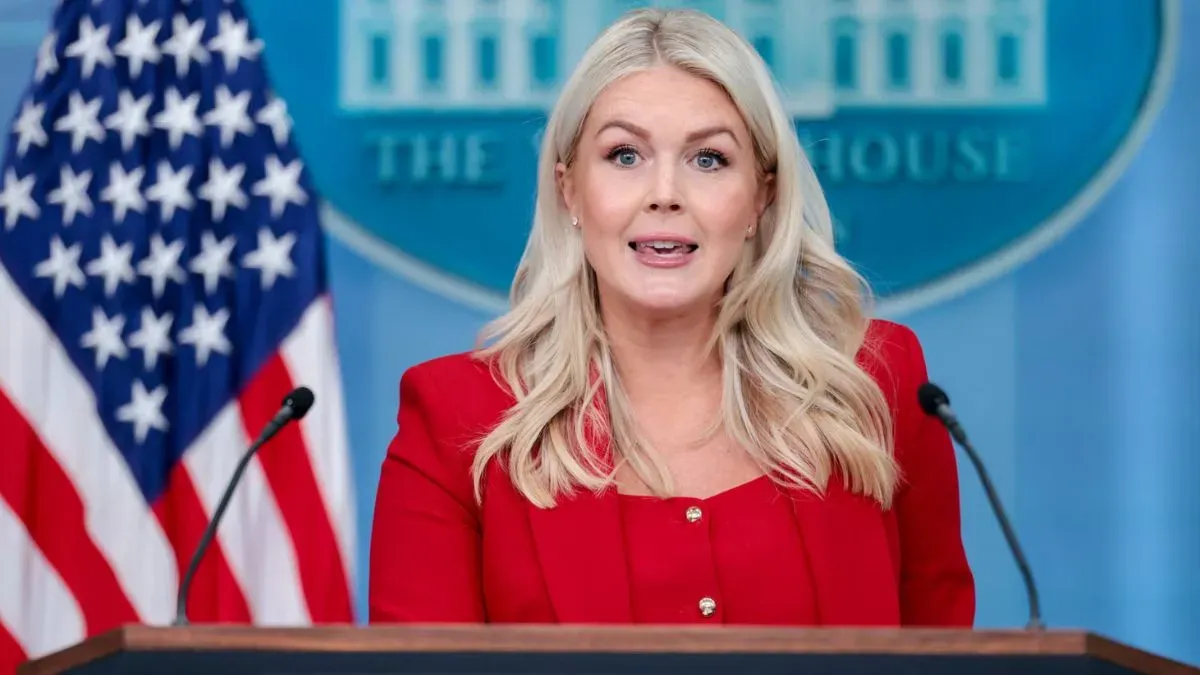
Karoline Leavitt’s resignation from her position as White House press secretary has raised questions about why she is leaving a role that made her the youngest person ever to serve in the position. President Donald Trump announced on August 12, 2026, that Leavitt would leave the post at the end of August, bringing her roughly 20-month tenure as the administration’s chief spokesperson to an end.
The main reason given for her departure is her family. Trump said Leavitt wanted to spend more time with her young children and family, and Leavitt has described the decision as a difficult but necessary choice. Her departure comes only months after she welcomed her second child, a daughter named Viviana, while already raising her two-year-old son, Nicholas “Niko” Riccio.
Leavitt’s decision does not mean she is completely leaving Trump’s political orbit or walking away from public life. Trump said she would become one of his top outside advisers and continue to have an influential role within the Republican Party. Her departure is therefore better understood as a resignation from the White House press secretary position rather than a complete exit from politics.
The timing is particularly notable because the United States is approaching the 2026 midterm elections. Leavitt has been one of Trump’s most visible defenders and has played a central role in communicating the administration’s policies to the public and the news media. Her decision to step away at such an important point in the political calendar has consequently attracted considerable attention.
Leavitt also recently returned to work following maternity leave. Her daughter was born in May, meaning she has been navigating the demands of a newborn alongside a job that requires constant availability, frequent press briefings and rapid responses to breaking political developments.
Rather than citing a political disagreement, conflict with Trump or a major dispute within the administration, the explanation publicly given for her resignation centres on the demands of motherhood and family life. That distinction is important because speculation about the reasons for a high-profile resignation can easily move beyond what has actually been confirmed.
Karoline Leavitt’s Resignation Comes After the Birth of Her Second Child
Table of Contents
ToggleThe arrival of Leavitt’s second child is central to understanding the timing of her decision. She and her husband, Nicholas Riccio, welcomed their daughter Viviana, who is also called Vivi, on May 1, 2026. The couple already had a son, Niko, who was born in July 2024.
Leavitt had announced her pregnancy in December 2025 while serving as White House press secretary. She said at the time that she and her husband were excited to expand their family and looked forward to watching their son become a big brother. Her pregnancy was notable because she became the first known pregnant person to serve as White House press secretary while holding the position.
After giving birth to Vivi, Leavitt took maternity leave before returning to her responsibilities. Her return meant stepping back into a job that had continued to demand her attention throughout her pregnancy and after the birth of her daughter. The combination of an infant at home and a demanding public role appears to have played a significant part in the decision she eventually made.
The White House press secretary position is unlike many conventional jobs because the person holding it serves as one of the administration’s most visible representatives. The role involves press briefings, media interviews, meetings, preparation for presidential events and responses to rapidly developing national and international stories.
For a parent with two very young children, that schedule can be especially challenging. Leavitt’s son was only two years old when she made the decision to resign, while her daughter was just three months old in August 2026.
The timing therefore gives important context to her announcement. She was not simply leaving after a long period away from public life. Instead, she was stepping down after returning from maternity leave and facing the reality of balancing an infant and a toddler with one of the most demanding communications positions in Washington.
Leavitt has also spoken about motherhood during her time in office, making clear that her children were an important part of her life even while she was carrying out her official responsibilities. Her resignation now places that part of her life at the centre of the explanation for her career decision.
For people searching for the reason behind Karoline Leavitt’s resignation, her young family is therefore the clearest explanation available. There is no confirmed indication that she was forced out of the administration or that Trump asked her to resign.
What Did Karoline Leavitt Say About Leaving Her Job?
Leavitt described her departure as a difficult decision after serving as White House press secretary since January 2025. Her comments focused on the significance of the job, her experience working for Trump and the challenge of balancing the position with her responsibilities as a mother.
Her resignation is particularly notable because she had become closely identified with Trump’s communications operation. She was frequently seen defending the administration, answering questions from reporters and promoting the president’s agenda. Her direct and combative style also made her a prominent figure beyond the formal responsibilities of her position.
Trump publicly praised her after announcing her departure. He described her as one of his most trusted aides and said he understood and respected her decision to spend more time with her children and family. His statement also made clear that he intends to keep Leavitt close to his political operation.
That continued relationship is significant. When a senior administration official resigns, the next question is often whether the person has fallen out of favour with the president. In Leavitt’s case, Trump’s decision to describe her as a trusted aide and offer her an outside advisory role suggests that the resignation should not be interpreted as a political break between the two.
Leavitt’s departure also comes after a tenure that brought considerable attention to the way the White House communicated with the media. She frequently defended Trump’s policies and decisions while challenging journalists during press briefings. Her approach helped make her a recognisable figure among Trump’s supporters as well as a controversial figure among some critics.
Despite the controversies surrounding her tenure, there has been no public announcement that she is resigning because of one specific dispute or scandal. The reason communicated by both Trump and Leavitt is her desire to devote more attention to her family.
That does not necessarily mean her political ambitions have ended. Leavitt is still young, has considerable experience in Republican politics and has already worked in multiple roles within Trump’s political network. Her new position as an outside adviser could allow her to remain influential without carrying the daily responsibilities of the White House press secretary.
Her resignation may therefore represent a change in the way she participates in politics rather than a retreat from politics altogether. With the 2026 midterms approaching, she could continue to contribute to Trump’s political operation while spending more time with her family.
What Did Karoline Leavitt Do as White House Press Secretary?
Karoline Leavitt became White House press secretary on January 20, 2025, after Trump returned to the presidency. At 27, she made history as the youngest person to hold the position, placing her at the centre of the administration’s relationship with the national media.
Her career in Trump’s political world began before her appointment. She previously worked in Trump’s first administration and later served as communications director for Republican Representative Elise Stefanik. She also became a spokesperson for Trump’s 2024 presidential campaign, where she gained further national exposure.
As press secretary, Leavitt was responsible for communicating the administration’s positions on major issues and representing the president before reporters. She held White House press briefings, responded to questions about Trump’s policies and frequently appeared on television and other media platforms.
Her approach to the role differed from that of some previous press secretaries. Leavitt often emphasised conservative and nontraditional media outlets and adopted a confrontational style when responding to journalists whose questions she believed were unfair or politically motivated.
Her time in the role was also marked by disputes over media access and the relationship between the Trump administration and traditional news organisations. These issues made her an important participant in the broader debate over how the White House should interact with the press.
Leavitt nevertheless maintained Trump’s support throughout most of her tenure. She became one of the administration’s most recognisable public defenders and was often called upon to respond to difficult political questions.
Her resignation therefore represents a significant change for the White House communications operation. She has been the administration’s press secretary for Trump’s entire second term so far, meaning her departure will require the president to select a new person to represent the White House before the media.
As of August 13, 2026, no permanent successor has been publicly named. The eventual choice could influence the administration’s media strategy as the midterm elections approach and as the White House faces continued scrutiny over its policies and political priorities.
For Leavitt, however, the end of the role appears to mark a transition rather than the conclusion of her political career. Her experience in the White House, on the campaign trail and in Republican communications gives her a substantial political background to draw from in whatever comes next.
What Happens to Karoline Leavitt After Her Resignation?
Karoline Leavitt is expected to remain politically active after leaving the White House. Trump said she would become one of his top outside advisers and continue as an influential voice within the Republican Party. This means her resignation should not be interpreted as a complete departure from Trump’s political movement.
Her new position could give her greater flexibility than the press secretary role. An outside adviser does not carry the same daily responsibility for White House press briefings, media relations and rapid responses to breaking news. That difference could allow Leavitt to continue working in politics while creating more time for her husband and two children.
The change also comes at a strategically important moment for Republicans. The 2026 midterm elections are approaching, and Trump’s political operation is expected to remain heavily focused on candidates, messaging and maintaining Republican support. Leavitt’s experience as a campaign spokesperson and White House communicator could make her valuable in that environment.
Her future may also extend beyond the immediate Trump administration. Because she is still in her twenties and has already held several significant political positions, she has plenty of time to pursue additional opportunities in Republican politics, communications or elected office.
Leavitt previously ran for Congress in New Hampshire in 2022 but lost the general election. Her political experience therefore includes campaigning for office as well as serving in government and working as a communications professional.
Whether she eventually seeks elected office again remains uncertain. There is currently no confirmed announcement that she plans to run for a particular position after leaving the White House. For now, the clearest indication is that she will remain connected to Trump as an outside adviser.
Her resignation may also change how the public views her. Until now, much of her identity has been tied to being Trump’s press secretary. Moving into an outside role could give her more freedom to develop her own political profile while continuing to support the president.
At the same time, her family will likely remain an important consideration. With Niko still a toddler and Vivi only a few months old, Leavitt’s decision suggests that she wants a different balance between public service and personal responsibilities.
What Karoline Leavitt’s Resignation Means for the White House
Karoline Leavitt’s resignation creates an immediate communications challenge for the Trump administration. The White House will need to find a new press secretary at a time when the administration is approaching the 2026 midterm elections and dealing with an intense political news cycle.
The press secretary is one of the most visible officials in any presidential administration. The person in the role must communicate the president’s position clearly while dealing with difficult questions, breaking news and sometimes hostile exchanges with reporters.
Leavitt’s replacement will therefore have to step into a position that already carries a distinctive style. During her tenure, she became closely associated with Trump’s direct approach to politics and his preference for challenging traditional media organisations.
The next press secretary could maintain that strategy or introduce a somewhat different approach. Until the White House announces a permanent replacement, it is difficult to know whether Trump’s communications operation will change significantly.
Her departure also creates an interesting political situation because she is leaving less than three months before the November midterm elections. The administration will need continuity in its messaging while also preparing for a major electoral contest.
Trump’s decision to retain Leavitt as an outside adviser could partly address that concern. Although she will no longer be standing at the White House podium every day, she can still contribute to political strategy and communications from outside the administration.
For Leavitt personally, the resignation marks the end of a historic chapter. She became the youngest White House press secretary in American history and served during a period of intense political division and media scrutiny.
Her decision also highlights the tension that can exist between demanding public service and family responsibilities. Leavitt has chosen to step away from a prestigious position while still at a relatively early stage of her political career, with the stated goal of spending more time with her children.
That makes her resignation different from a conventional political departure. She is not retiring from public life, nor has she announced a complete break with Trump. Instead, she is moving from one of the most demanding jobs in the administration to an outside advisory role that may give her more control over her time.
Read More: Atty Sheila Sison Biography: Career, Age, Early Life & Education
Frequently Asked Questions About Karoline Leavitt’s Resignation
Why is Karoline Leavitt resigning?
Karoline Leavitt is resigning as White House press secretary primarily to spend more time with her young family. President Trump and Leavitt both indicated that her two young children were an important reason for the decision.
When is Karoline Leavitt leaving the White House?
Karoline Leavitt is expected to leave her position as White House press secretary at the end of August 2026. Her resignation was announced by President Donald Trump on August 12.
Is Karoline Leavitt leaving politics?
No. Leavitt is not completely leaving politics. Trump said she would become one of his top outside advisers and remain an influential figure within the Republican Party.
Is Karoline Leavitt being fired by Trump?
There is no public indication that Leavitt was fired. Trump announced her departure while praising her work and saying he understood and respected her decision to spend more time with her family.
Why did Karoline Leavitt leave after maternity leave?
Leavitt returned to work after taking maternity leave following the birth of her daughter, Viviana, in May 2026. Her subsequent resignation reflects the difficulty of balancing a demanding White House position with raising an infant and a toddler.
How many children does Karoline Leavitt have?
Karoline Leavitt has two children with her husband, Nicholas Riccio. Her son Niko was born in July 2024, while her daughter Viviana was born in May 2026.
Who will replace Karoline Leavitt?
As of August 13, 2026, the Trump administration has not publicly announced a permanent replacement for Karoline Leavitt as White House press secretary.
How long did Karoline Leavitt serve as White House press secretary?
Leavitt served as White House press secretary from January 2025 until her planned departure at the end of August 2026. Her tenure lasted roughly 20 months.
How old was Karoline Leavitt when she became press secretary?
Karoline Leavitt was 27 when she became White House press secretary in January 2025. Her appointment made her the youngest person to hold the position in American history.
What will Karoline Leavitt do after leaving the White House?
Leavitt is expected to serve as an outside adviser to Donald Trump and remain active as an influential Republican voice. Her new role is expected to allow her to remain involved in politics without the daily demands of the White House press secretary position.
Conclusion
Karoline Leavitt’s resignation marks the end of a historic period in which she became the youngest White House press secretary in American history and one of Donald Trump’s most visible political defenders. Her decision to leave the role has attracted widespread attention because it comes while the administration is approaching the 2026 midterm elections.
The reason given for her departure is straightforward. Leavitt wants to spend more time with her family, particularly her two young children, Niko and Vivi. Her daughter was born only three months before the announcement, while her son is still just two years old, making the demands of motherhood especially significant at this stage of her life.
Importantly, Leavitt is not disappearing from politics. Trump has said she will remain a top outside adviser and an influential Republican voice, giving her a way to continue working within his political movement without carrying the demanding daily responsibilities of the White House press secretary position.
Her resignation is therefore best understood as a major career transition rather than a complete political exit. For now, Leavitt appears to be choosing a role that allows her to remain close to Trump’s political operation while giving herself more time to raise her young family.